
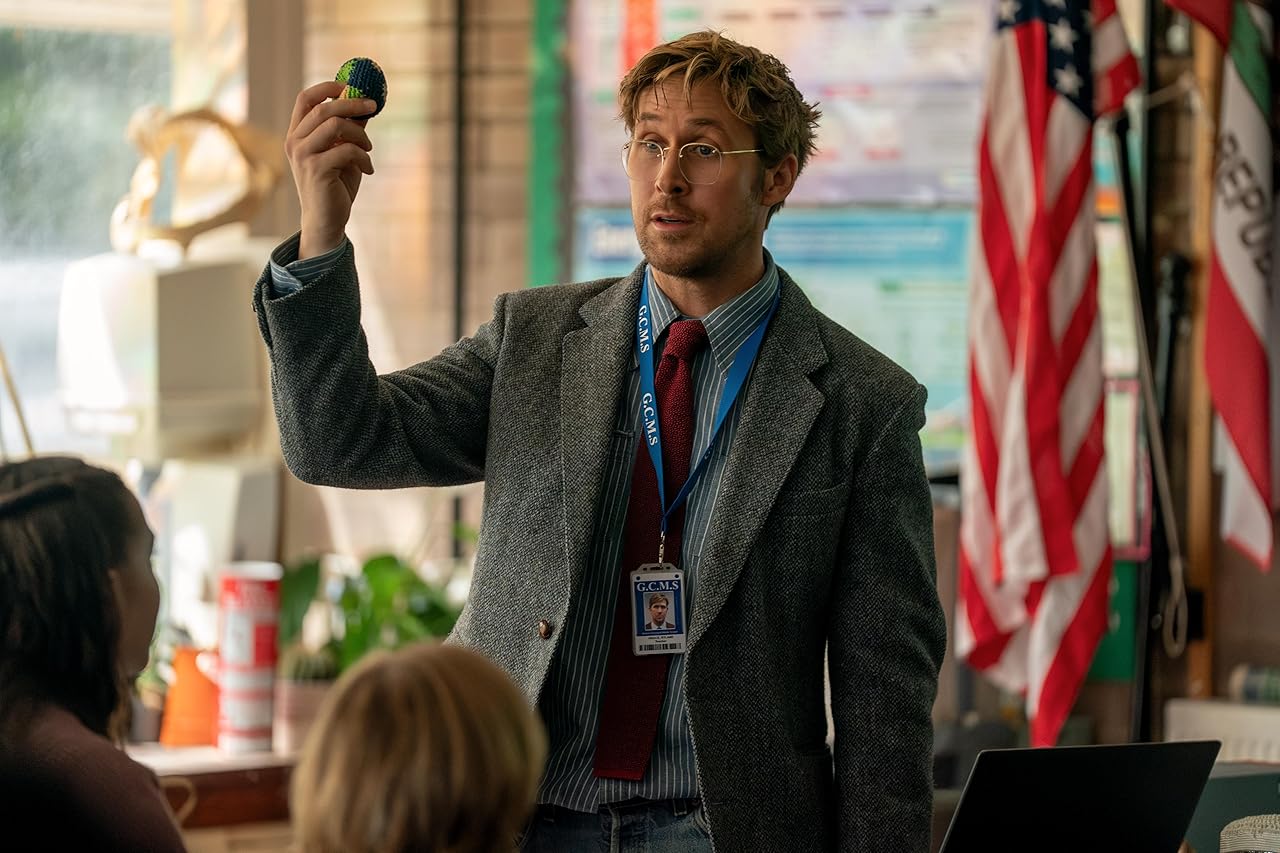
Ryan Gosling has made a career out of playing men who communicate poorly—stoic drivers, silent stuntmen, Ken (who technically talks a lot but mostly about patriarchy). So it’s fitting that his most challenging co-star in Project Hail Mary was an alien who doesn’t speak English, and that his acting coaches for these scenes were his two young daughters, who volunteered their voices when the actual performer wasn’t available.
The actor revealed this adorable behind-the-scenes detail in a recent interview, and it’s the kind of story that makes you rethink everything you know about Hollywood production. Here you have a $100 million sci-fi epic, directed by Phil Lord and Christopher Miller, based on a novel by Andy Weir, featuring a desperate mission to save Earth—and the lead actor is performing opposite his children, who are reading lines for an alien named Rocky while wearing pajamas and probably demanding snacks between takes.
Gosling plays Ryland Grace, a schoolteacher-turned-astronaut who wakes up on a spaceship with no memory of how he got there, accompanied only by an alien creature who becomes his unlikely ally. The relationship between Grace and Rocky is the emotional core of the film, requiring Gosling to form a genuine connection with a CGI character added in post-production. This is standard practice in modern filmmaking—actors perform against tennis balls on sticks, or stand-ins, or nothing at all. But Gosling had something better: his daughters.
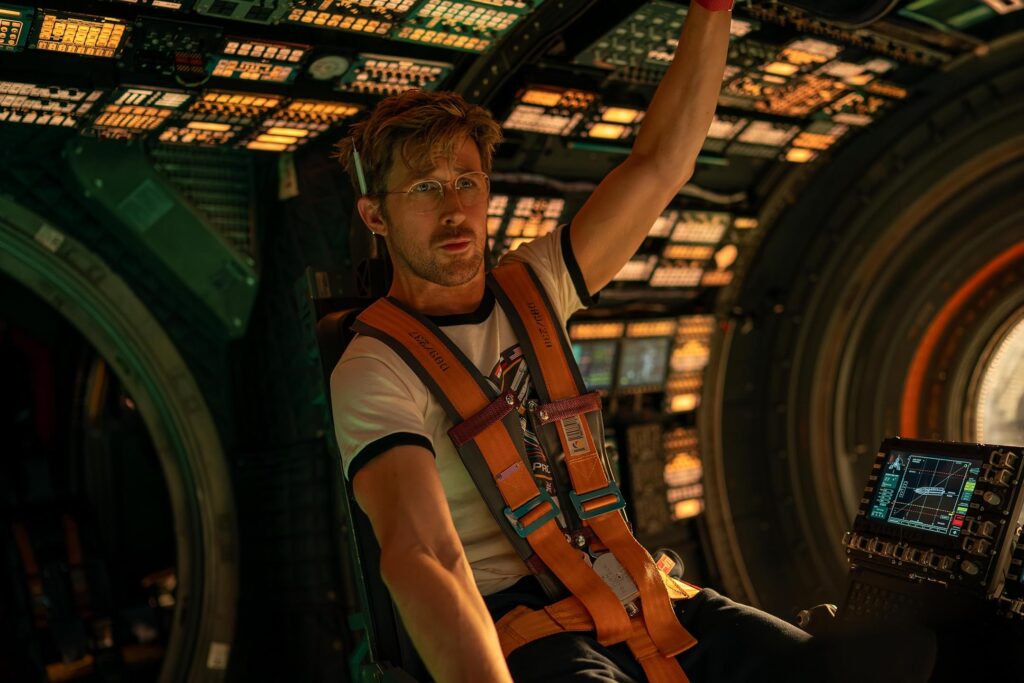
“They would voice Rocky for me off-camera,” Gosling explained, clearly delighted by the memory. “They’d be like, ‘Daddy, Rocky says…'” and then deliver the line with the kind of enthusiasm that professional actors spend years trying to fake. The image is irresistible: Gosling, in full astronaut gear, having an emotional breakthrough while his kids giggle in the corner, occasionally breaking character to ask for juice or complain about being bored.
This isn’t just a cute anecdote; it’s a window into how Gosling approaches his work. He’s known for being intensely prepared, for finding the emotional truth in every scene, but he’s also clearly a father who wants his children to understand what he does. By involving them in the process, he demystified the magic of filmmaking while simultaneously making it more magical. They weren’t just visiting the set; they were contributing to the art.
The daughters—Esmeralda and Amada, whom Gosling shares with Eva Mendes—are apparently quite the performers in their own right. Their voicing of Rocky wasn’t monotone or distracted; they committed to the character, understanding (on some level) that they were helping their father create something important. This is the kind of creative parenting that produces either future artists or future people who need extensive therapy to deal with their childhoods. Based on Gosling’s evident delight, probably the former.
Project Hail Mary represents a shift in Gosling’s career. After the massive success of Barbie, he’s leaning into blockbuster filmmaking while maintaining his indie credibility. The film requires him to carry long stretches of screen time alone, communicating complex scientific concepts while building a relationship with a creature that won’t exist until visual effects artists create it months later. It’s the kind of performance that looks effortless but requires enormous technical skill and emotional availability.
Knowing that his daughters were present for this process adds another layer to the performance. Grace is a character defined by isolation, by the terror of being alone in the universe, and Gosling was performing that isolation while surrounded by family. The tension between the character’s experience and the actor’s reality probably informed the work in ways that are invisible but essential. Art often comes from these contradictions.
Lord and Miller, the directors, are known for creating playful, collaborative sets where improvisation is encouraged and accidents become features. The presence of Gosling’s children fits perfectly into this ethos—why use a script supervisor to read lines when you can use a seven-year-old who will deliver them with unexpected inflections? The film probably benefited from this unpredictability, from the genuine reactions Gosling gave to performances that weren’t technically “professional.”
The story also humanizes Gosling in a way that his public persona often resists. He’s cultivated an image of cool detachment, of being slightly above the Hollywood fray, but this anecdote reveals a dad who is clearly besotted with his kids, who thinks their contributions are genuinely valuable, who wants to share his work with them. It’s sweet without being saccharine, impressive without being pretentious.
Project Hail Mary arrives in theaters March 20, 2026, and now audiences will watch the Grace-Rocky scenes with new knowledge. Every emotional beat, every moment of connection, was partially shaped by two children who were just trying to help their dad. That’s cinema magic of the best kind—the kind that happens off-camera, in the spaces between takes, in the genuine love of a family making art together.
See Project Hail Mary in theaters starting March 20, 2026, and watch for the scenes where Ryan Gosling connects with his alien co-star—knowing that his daughters helped make that magic happen.
Also Read: Megan Fox Is Back on Instagram and She’s Not Here to Play It Safe