

Christopher Nolan has built his career on making audiences feel intellectually inadequate while simultaneously blowing their minds with spectacle. Two of his most ambitious films—Oppenheimer and Interstellar—represent the twin poles of his artistic preoccupations: the historical biopic as psychological thriller versus the science fiction epic as emotional odyssey.

Choosing between them is like choosing which of your children you love more, except the children are three hours long and require you to understand quantum mechanics.
Oppenheimer arrived in 2023 as Nolan’s first R-rated film in decades, a three-hour descent into the psyche of J. Robert Oppenheimer as he creates the atomic bomb and subsequently watches the world realize exactly what he has unleashed. It’s a film of claustrophobic interiors, ticking clocks, and Cillian Murphy’s haunting blue eyes staring into the abyss of his own creation.
The film operates through juxtaposition—color sequences of subjective experience versus black-and-white objective reality—creating a fractured narrative that mirrors its protagonist’s fractured psyche.

Interstellar, released in 2014, takes the opposite approach. Where Oppenheimer is dense, crowded, and historically grounded, Interstellar is vast, lonely, and cosmically ambitious. Matthew McConaughey plays Cooper, a pilot turned farmer turned astronaut who must leave his children behind to find a new habitable planet for humanity. The film spans wormholes, black holes, and time dilation, culminating in a third-act reveal about love transcending dimensions that divides audiences to this day.
Visually, Interstellar maintains an edge. The film’s depiction of Gargantua—the supermassive black hole—required new scientific understanding and rendered some of the most accurate astrophysical imagery ever committed to film. The cornfields of Earth give way to the water world of Miller’s planet, the ice clouds of Mann’s planet, and the tessaract’s infinite bookshelf of time.

It’s a film that demands the biggest screen possible, shot on 70mm IMAX film with a reverence for practical effects and location shooting that makes the cosmic feel tactile.
Oppenheimer counters with intimacy. The Trinity test sequence may be the most terrifying depiction of an explosion ever filmed—not because of the destruction, but because of the anticipation. We watch Oppenheimer’s face as he waits for the detonation, knowing that success means creating a weapon capable of ending civilization.
The film’s final act, depicting the security hearing that stripped Oppenheimer of his clearance, plays like a horror movie where the monster is the United States government and the victim is a man who dared to express doubts about his own creation.
Thematically, both films wrestle with responsibility—Oppenheimer with the moral weight of creating weapons of mass destruction, Cooper with the personal sacrifice of abandoning his family to save the species. Both feature protagonists who are brilliant but flawed, driven by ego and idealism into situations they cannot fully control.
Both end with their heroes achieving a kind of tragic redemption: Oppenheimer through his public humiliation becoming a warning against nuclear proliferation, Cooper through his reunion with Murph after decades apart.
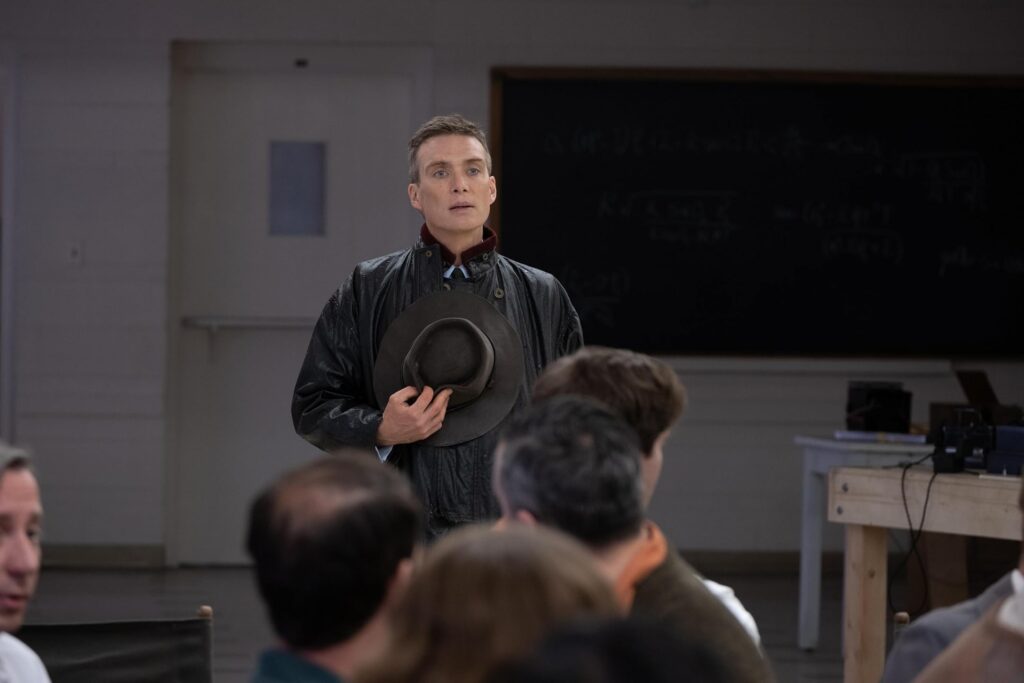
What distinguishes them is scope. Oppenheimer is a film about one man and one moment that changed history. Interstellar is a film about all of humanity and its potential future among the stars. Oppenheimer’s climax is a courtroom confrontation; Interstellar’s is a desperate docking sequence with a rotating space station. Both are nail-biting, but one is nail-biting because of dialogue and the other because of physics.
The verdict? They serve different appetites. Oppenheimer is the mature work of a director confident in his ability to make history feel immediate. Interstellar is the ambitious work of a director still reaching for the cosmic sublime. Both are essential Nolan, both are masterpieces of their respective modes, and both will leave you staring at the ceiling at 3 a.m. wondering about the nature of time, responsibility, and whether love can actually transcend dimensions. (It can’t. But it’s nice to imagine.)
Experience both epics—stream Oppenheimer and Interstellar and decide for yourself which Christopher Nolan masterpiece reigns supreme.
Also Read: Full Avengers Doomsday Plot Leak Reveals Multiverse-Shattering Ending