
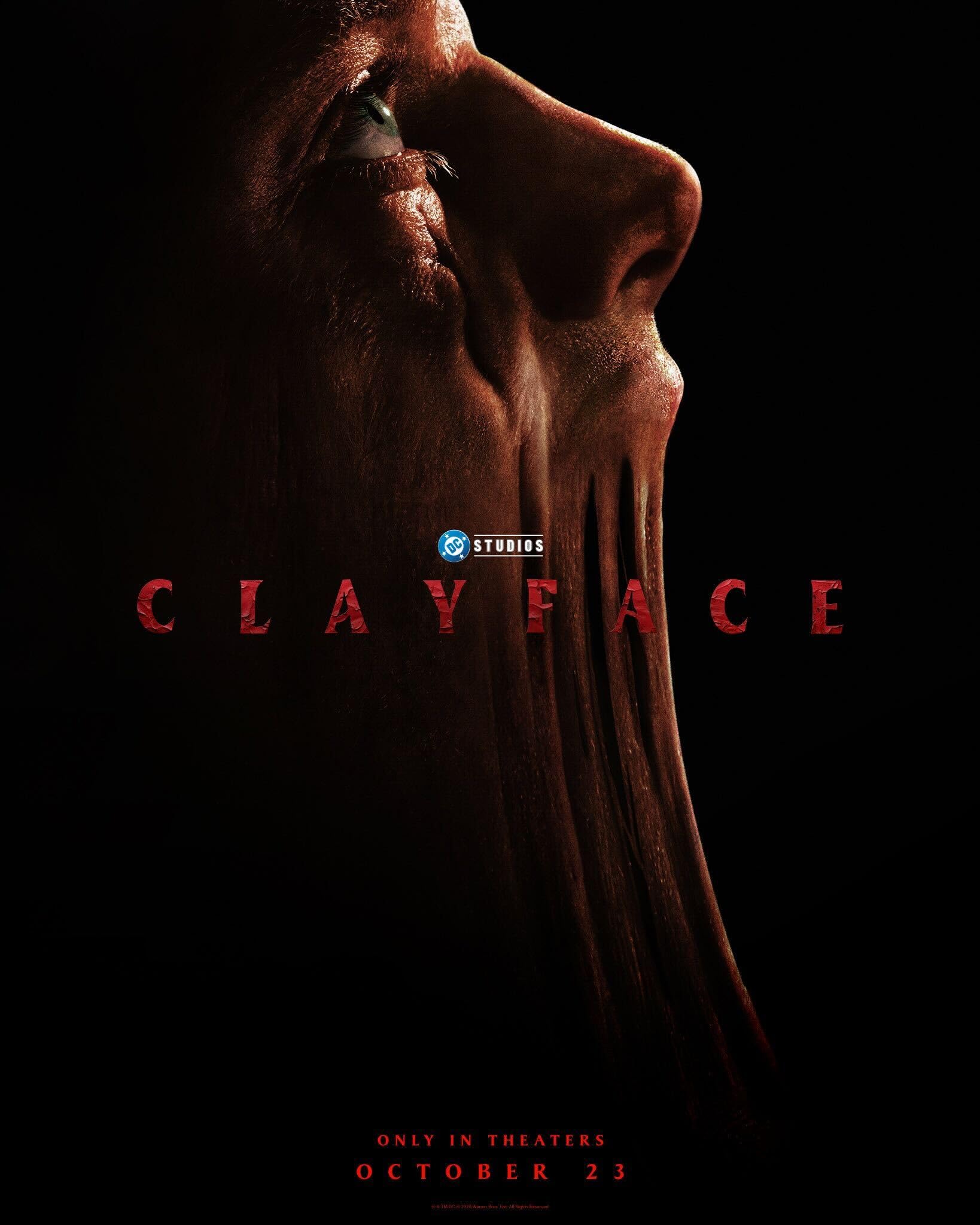
Movie posters are supposed to sell tickets, not induce existential dread. The official poster for Clayface has other ideas. Released ahead of the teaser trailer, the one-sheet manages to be more genuinely unsettling than most horror films manage in ninety minutes of screen time, establishing the tone for James Gunn’s DC Universe before a single frame of footage was seen.
The poster features Matt Hagen in mid-transformation, his face beginning to lose definition as clay overtakes human features. It’s not quite monster, not quite man—a liminal space of body horror that triggers the same instinctive revulsion as watching someone peel off a sunburn or pull out a loose tooth. The tagline “Look fear in the face” is almost redundant; the image does all the work, staring back at you with eyes that might not actually be eyes anymore.
What makes the poster effective is its restraint. This isn’t a screaming ghost or a masked killer or some CGI creature with too many teeth. It’s a person becoming something else, losing the face they were born with, and the horror is in the recognition that this could happen to anyone. The clay isn’t green or obviously monstrous; it’s flesh-toned, organic, wrong in a way that bypasses your conscious brain and goes straight to the lizard part that knows when something isn’t right.
James Gunn has been talking about Clayface with the enthusiasm of a man who finally gets to make the weird movie he’s been pitching for years. “Totally real,” he keeps saying. “True and psychological and body horror and gross.” The poster delivers on all those adjectives without showing a single act of violence. It suggests the horror rather than displaying it, which is always more effective than the alternative.
The design echoes classic horror posters from the 1970s and 80s—think The Thing or Videodrome—where the image was simple but the implications were vast. You didn’t need to see the monster in action to know it would be terrifying; the poster established the aesthetic, and your imagination filled in the rest. Clayface operates on the same principle. One look at that melting face and you’re already constructing the nightmares the film will hopefully deliver.
Tom Rhys Harries, the actor playing Matt Hagen, has the unfortunate task of promoting a film where his character’s face is literally falling off. Naomi Ackie, as the scientist who enables this transformation, gets to look concerned in the poster, which is probably the appropriate reaction when your experimental treatment turns a patient into a shape-shifting clay monster. The supporting cast—David Dencik, Max Minghella, Eddie Marsan—are nowhere to be seen, presumably because the poster knows that one melting face is enough.
Matt Reeves produces, bringing the same atmospheric dread that made The Batman feel like a horror movie disguised as a superhero film. Mike Flanagan and Hossein Amini’s script apparently convinced Gunn and Safran to greenlight a project they initially had “no plans” to make, which suggests the writing was strong enough to override corporate caution. When a script about a C-list Batman villain can convince studio heads to invest in body horror, you know the material is exceptional.
The poster’s release timing—ahead of CinemaCon, ahead of the teaser, ahead of any footage—shows confidence in the visual identity of the project. DC Studios isn’t hiding this film behind generic superhero imagery. They’re leading with the grotesque, the uncomfortable, the genuinely scary. It’s a gamble that pays off because it distinguishes Clayface from every other comic book movie on the horizon.
By October 23, audiences will know whether the film delivers on the poster’s promise. But for now, that one image is doing more marketing work than a thousand CGI explosions. It’s reminding us that horror doesn’t need jump scares or loud noises. Sometimes all it needs is a face that isn’t quite a face anymore, staring back at you with eyes that might be windows to a soul, or might just be holes in clay.
Face your fears—see Clayface in theaters October 23 and discover what happens when a poster’s promise becomes a movie’s reality.
Also Read: Scary Movie 6 Just Parodied Michael Jackson and the Internet Needs a Minute