
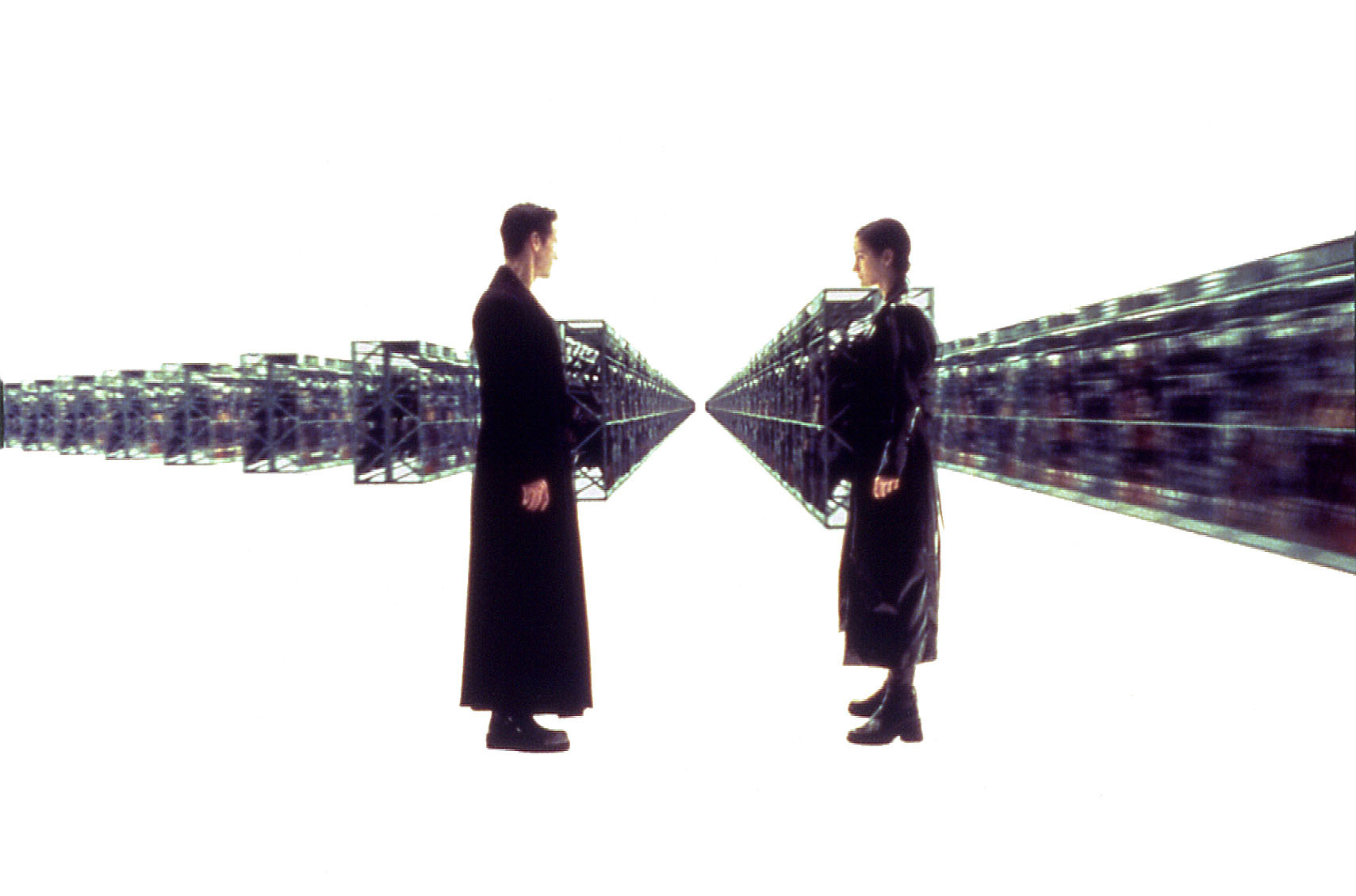
Every screenwriting teacher will tell you that your protagonist should appear in the first ten minutes. The Wachowskis said “screw that” and opened The Matrix with six minutes of Carrie-Anne Moss in leather pants performing impossible stunts while being chased by Hugo Weaving in a suit. It was a $10 million gamble that convinced Warner Bros. to fund the rest of the movie, and it remains one of the most important decisions in modern action cinema.
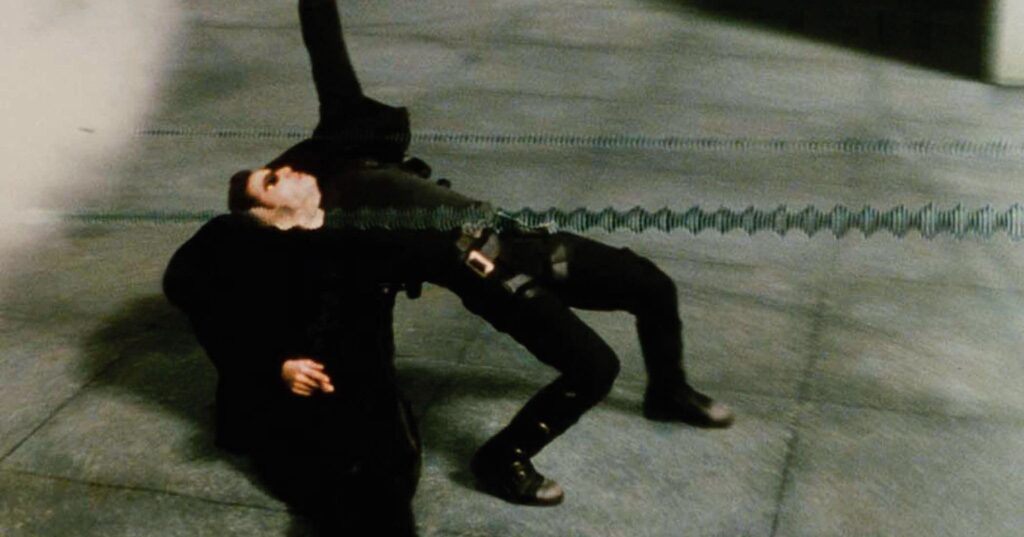
The opening sequence is pure adrenaline. Trinity sits in a dingy hotel room, typing cryptic messages to her crew about “the one,” when police burst in to arrest her. She responds by climbing walls, fighting off a dozen officers, and sprinting across rooftops with Agents in pursuit. The camera follows her through impossible angles—spinning around her as she hangs in mid-air, tracking her as she leaps between buildings, staying with her as she disappears into a ringing payphone just as a garbage truck crashes into the booth.
But here’s the genius part: we don’t know who she is. We don’t know who the Agents are. We don’t understand the rules of this world or why gravity seems optional. The Wachowskis drop us into the deep end of their mythology and trust that we’ll figure out the swimming strokes as we go. It’s the cinematic equivalent of starting a novel with the second chapter, and it works because Trinity is so compelling that we don’t care about the confusion.
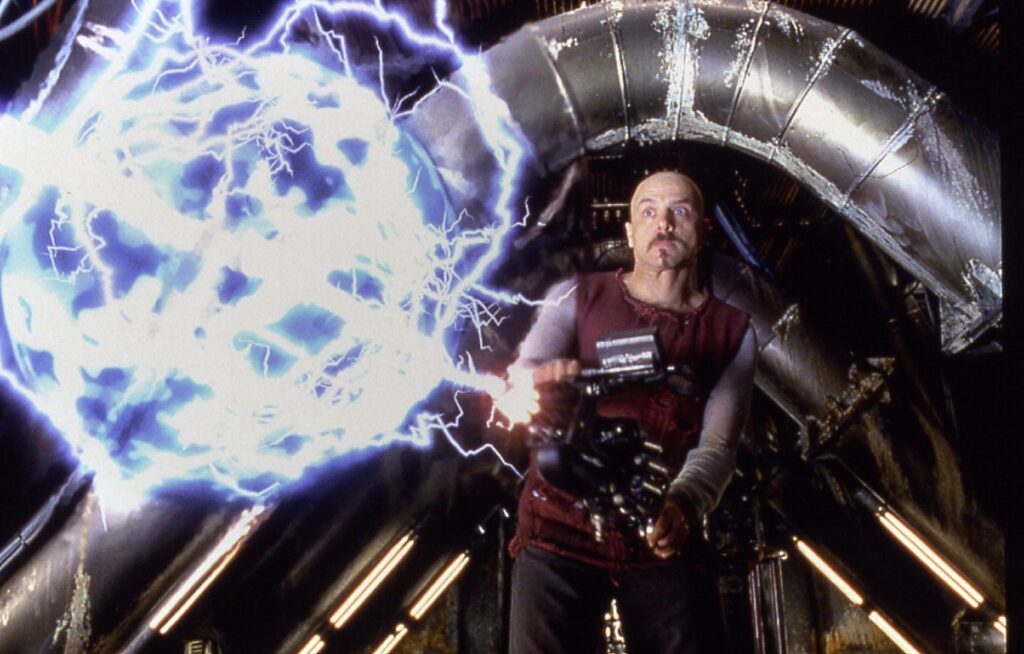
Opening with Trinity instead of Neo fundamentally changes how we experience the film. When we finally meet Thomas Anderson, he’s a confused programmer having cryptic conversations about rabbits and White Rabbits on his computer. He’s passive, uncertain, and completely out of his depth. If we had started with him, The Matrix would feel like a standard hero’s journey where a nobody becomes special. By starting with Trinity, the film establishes that the world already has capable heroes—we’re just waiting for the protagonist to catch up to them.
Trinity’s introduction also establishes the visual language of the Matrix before we understand what the Matrix is. The green tint, the impossible physics, the martial arts that ignore conservation of momentum—all of it appears in this opening sequence. By the time Neo learns about the reality of his existence, we’ve already accepted the rules because we saw Trinity break them six minutes in.
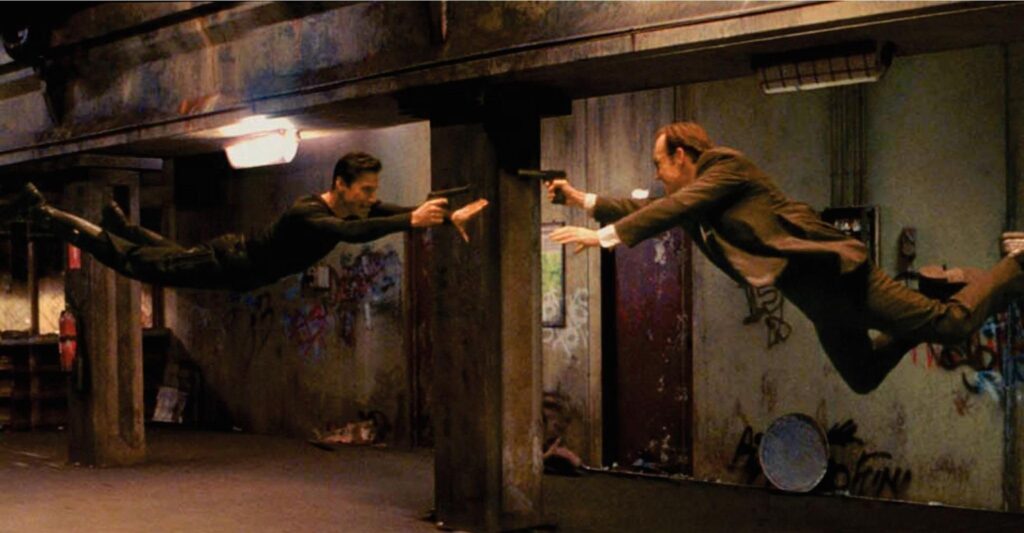
The scene also sets up the hierarchy of power. The Agents are terrifying because they pursue Trinity with relentless efficiency, and Trinity is clearly skilled enough to evade them. When Agent Smith tells the police lieutenant that his men are “already dead,” it’s not arrogance—it’s observation. Trinity moves through conventional law enforcement like a wolf through a petting zoo.
Most importantly, starting with Trinity establishes that this is her story too. The Matrix isn’t just about Neo’s messianic journey; it’s about Trinity’s choice to believe in him, to love him, to bring him back from the dead with a kiss that rewrites the code of the simulation. By giving her the opening scene, the Wachowskis signal that Trinity is the co-protagonist, not the love interest. She’s the one who finds Neo, who convinces him to meet Morpheus, who pulls him out of the Matrix literally and figuratively.
The decision to spend $10 million on the opening scene before the studio had fully committed to the film was a massive risk. But the Wachowskis understood that you can’t describe The Matrix; you have to see it. Words like “bullet time” and “simulation” mean nothing until you watch Trinity freeze in mid-kick and the camera spin around her. That visual proof of concept is what convinced Warner Bros. to greenlight the remaining $60 million budget.
Twenty-six years later, the opening still holds up. The wire work is visible in a few shots, the CGI is slightly dated, but the energy—the sense that you’re watching something genuinely new—is undiminished. Trinity’s escape remains a masterclass in economical storytelling. No dialogue explaining the plot. No exposition dumps about the nature of reality. Just a woman running for her life in a world where the laws of physics are negotiable.
Sometimes the best way to introduce your hero is to show us who he’s trying to become.
Take the red pill—rewatch The Matrix and appreciate how six minutes of Trinity changed action cinema forever.
Also Read: Predator Is Still the Ultimate Macho Movie That Hates Macho Movies