

At the end of Dune: Part Two, Chani did something she never did in Frank Herbert’s original novel—she walked away. Instead of accepting Paul’s marriage to Princess Irulan as a political necessity, she stormed out of the throne room, wrapped a blue headband around her head (signaling pregnancy in Fremen culture), and rode off into the desert on a sandworm, leaving her Lisan al-Gaib to his empire and his holy war.
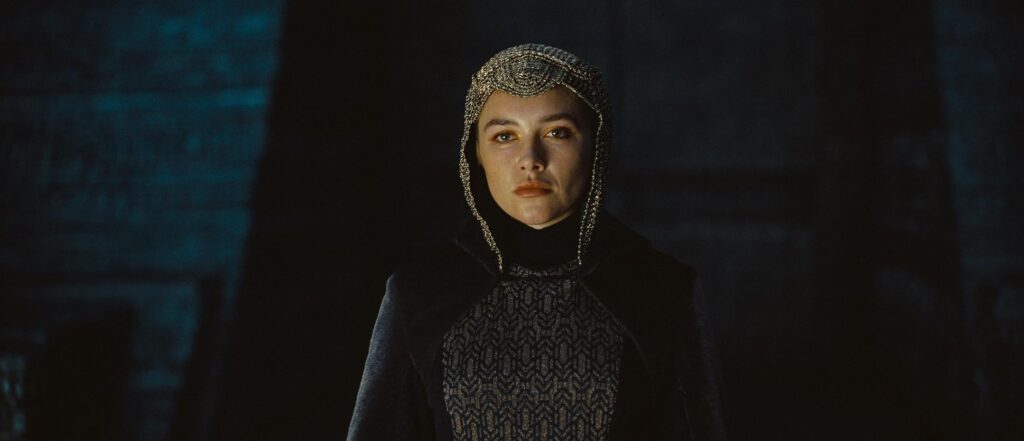
This radical departure from the source material sets up Dune: Part Three to explore a relationship dynamic that is simultaneously more fractured and more complicated than the book’s version of Paul and Chani’s twelve-year arrangement.
In Herbert’s Dune Messiah, Chani remains Paul’s concubine while Irulan occupies the position of wife in name only. Paul makes it clear to Chani that he will never consummate the marriage with Irulan, that his heir will be Chani’s child, and that the political alliance is purely transactional. The book’s Chani accepts this arrangement, remaining loyal to Paul throughout his reign even as the jihad rages across the universe and sixty-one billion people die in his name.
She serves as his moral compass and his emotional anchor, the one person who knew him before he became Muad’Dib.
Villeneuve’s Chani, however, has already rejected that role. Her departure at the end of Part Two was fueled by betrayal—not just Paul’s political marriage, but his embrace of the messianic identity she spent the entire film warning him against. She saw how the Fremen were manipulated, how the prophecy was weaponized, and how Paul chose power over principle. When she rides off into the desert, she isn’t just leaving a man; she’s leaving the entire system of belief that elevated him.

Part Three picks up seventeen years later, and the trailer suggests a reconciliation of sorts. Paul and Chani are shown discussing baby names—Ghanima for a girl, Leto for a boy—in a tender moment that implies she has returned to his side. But the context matters. In the book, Chani’s pregnancy is a source of tension because Princess Irulan, acting on Bene Gesserit orders, secretly feeds her contraceptives to prevent the birth of an heir outside their control.
When Chani switches to traditional Fremen fertility practices and conceives, it sets up the tragic climax where she dies giving birth to twins.
Villeneuve’s version seems poised to complicate this further. The trailer shows Chani looking deeply conflicted, still wearing Fremen gear rather than imperial finery, suggesting she remains apart from Paul’s court even if she has returned to his bed. Their relationship in Part Three appears to be one of estranged intimacy—physically close, emotionally distant, bound by love but divided by the consequences of Paul’s choices.
The power dynamic has shifted irrevocably. Paul is now Emperor, prescient, functionally immortal in his ability to see the future, and worshipped as a god by billions. Chani is still the desert woman who fell in love with a boy named Paul Atreides, not the tyrant Muad’Dib. The trailer hints that she may be working against him, or at least operating outside his influence—she is shown separately from the imperial court, still moving through desert spaces while Paul rules from a throne.
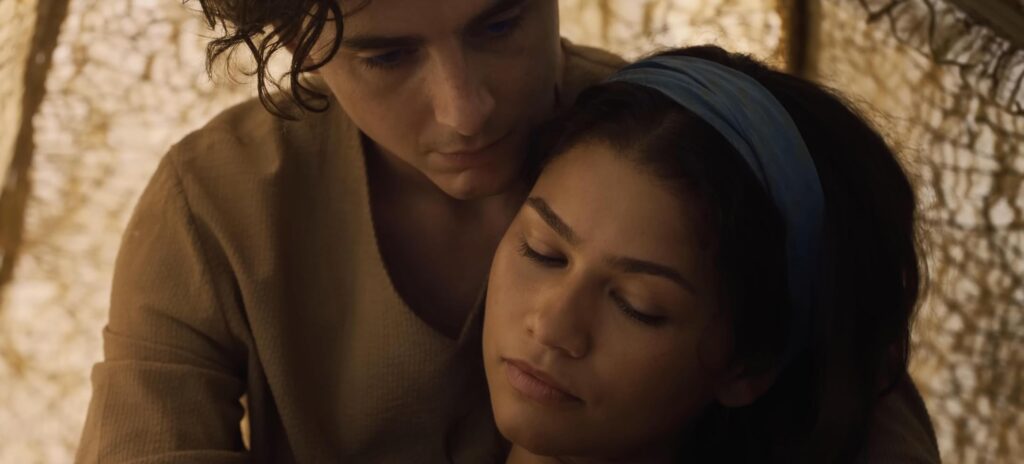
This aligns with Villeneuve’s stated goal of making Part Three a thriller about people trying to overthrow an invincible emperor. If Chani is part of that resistance, or at least sympathetic to it, the film transforms their relationship from the book’s supportive partnership into something more tragic—a love story where both parties are trying to save each other from themselves, but from opposite sides of a political divide.
The book’s tragic ending—Chani dying in childbirth while Paul, blinded by an assassination attempt, wanders into the desert to die—may play differently if Villeneuve maintains this tension. In the novel, her death is the final straw that makes Paul give up his empire. In the film, if they have spent seventeen years estranged, her death might instead represent the final severing of his last tether to humanity, completing his transformation into the tyrannical figure the conspiracy seeks to destroy.
Witness the tragedy—see Dune Part 3 in theaters December 18, 2026, and discover whether Paul and Chani’s love can survive the weight of empire.
Also Read: Dune: Part 3 Box Office Projections vs Dune Part 2 Performance Comparison