
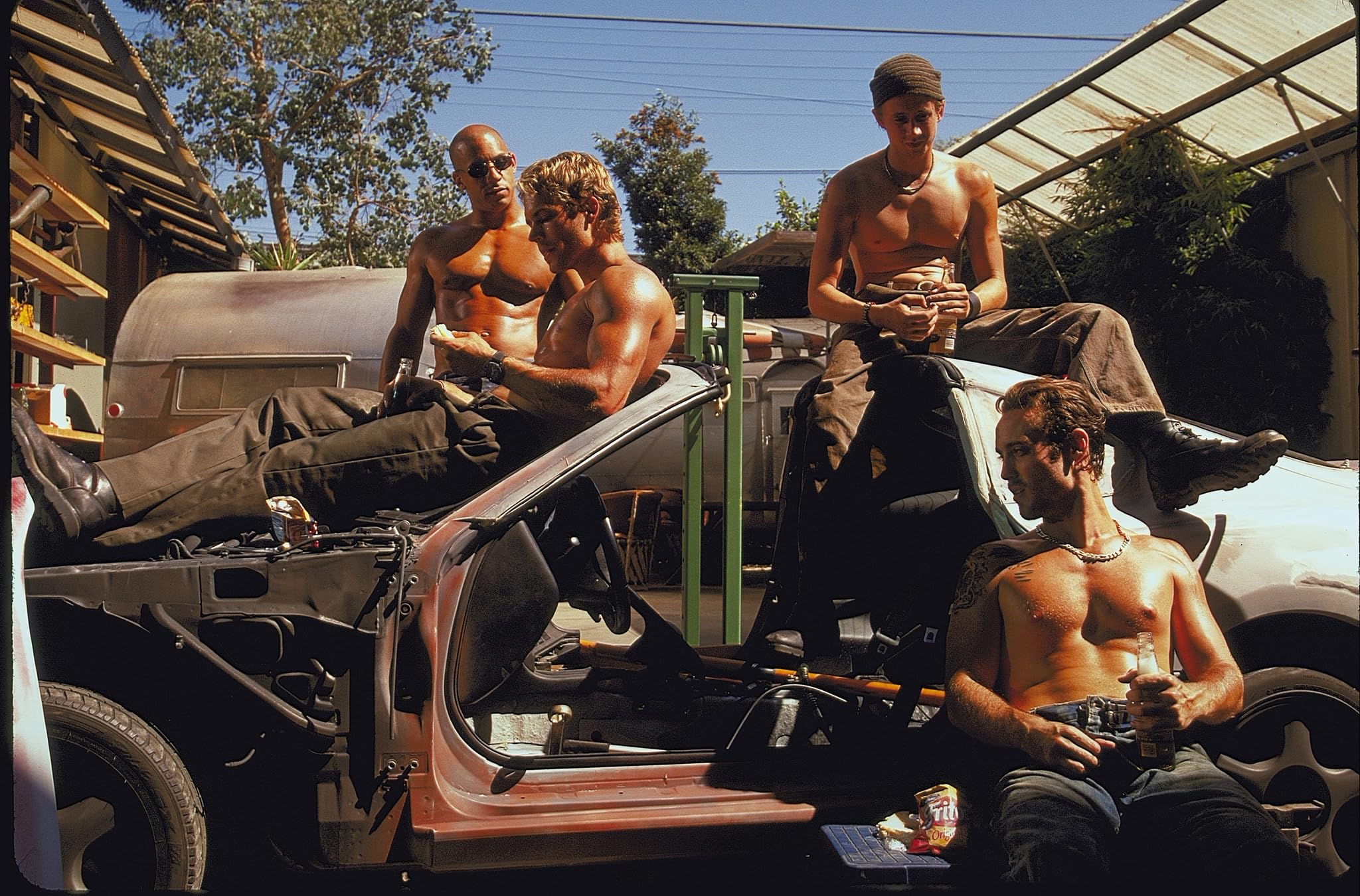
In the summer of 2001, a movie about undercover cops and street racers opened to modest expectations and surprisingly strong box office. It was called The Fast and the Furious, and everyone involved assumed it would be a one-off—a fun little action flick that might spawn a direct-to-video sequel at best. Twenty-five years and ten sequels later, it’s the most improbable franchise in Hollywood history, having morphed from a Point Break ripoff into a superhero saga where cars fly through space and the word “family” is uttered with religious fervor. But to understand how we got here, we have to go back to the beginning, when it was just Paul Walker, Vin Diesel, and a bunch of modified Honda Civics.
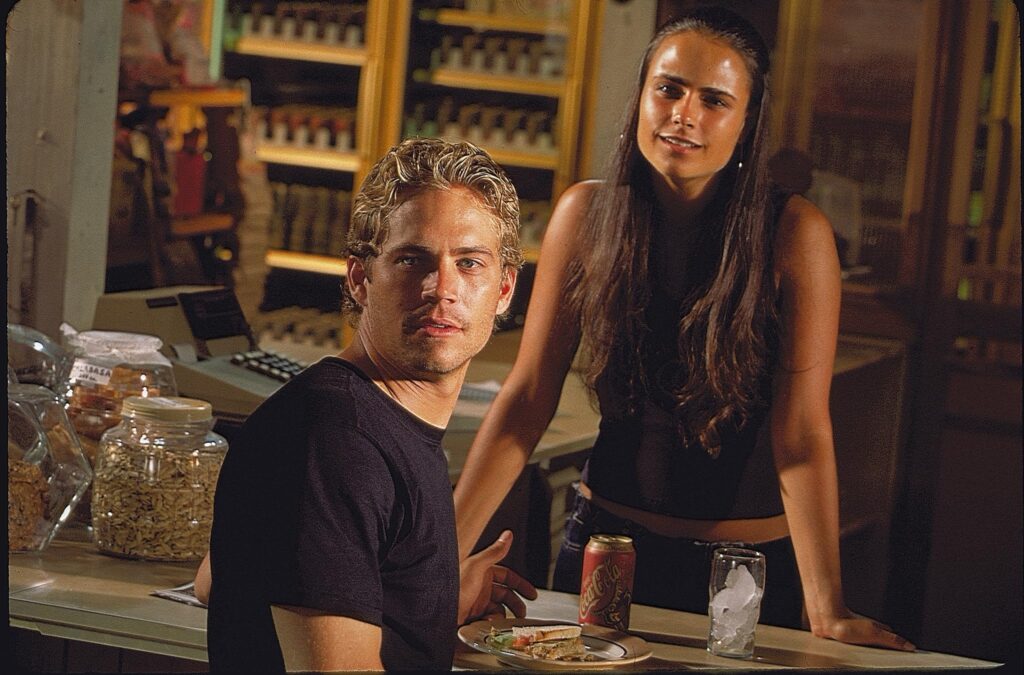
The origins of the franchise trace back to a May 1998 issue of Vibe magazine. Ken Li’s article “Racer X” detailed the underground street racing scene in New York City, profiling kids who spent tens of thousands of dollars customizing Japanese imports and racing them illegally on public streets. Rob Cohen, a director who had just worked with Paul Walker on The Skulls, read the article and saw potential. When he asked Walker what his dream action movie would be, Walker suggested a mashup of Days of Thunder (fast cars) and Donnie Brasco (undercover cops). The Vibe article provided the world; Walker’s suggestion provided the structure.
Cohen developed the story with Gary Scott Thompson, Erik Bergquist, and David Ayer, the latter of whom transformed the script from a “mostly white and suburban” New York story into a diverse Los Angeles-set thriller. The plot was simple to the point of being derivative: Brian O’Conner, an undercover LAPD officer, infiltrates the street racing crew of Dominic Toretto, falls in love with Dom’s sister Mia, and must choose between his loyalty to the law and his loyalty to his new family. If this sounds suspiciously like Point Break with cars instead of surfboards, that’s because it is. Director Kathryn Bigelow’s 1991 classic featured an FBI agent infiltrating a gang of bank-robbing surfers led by a charismatic guru—swap surfing for racing and Patrick Swayze for Vin Diesel, and you have the basic blueprint.
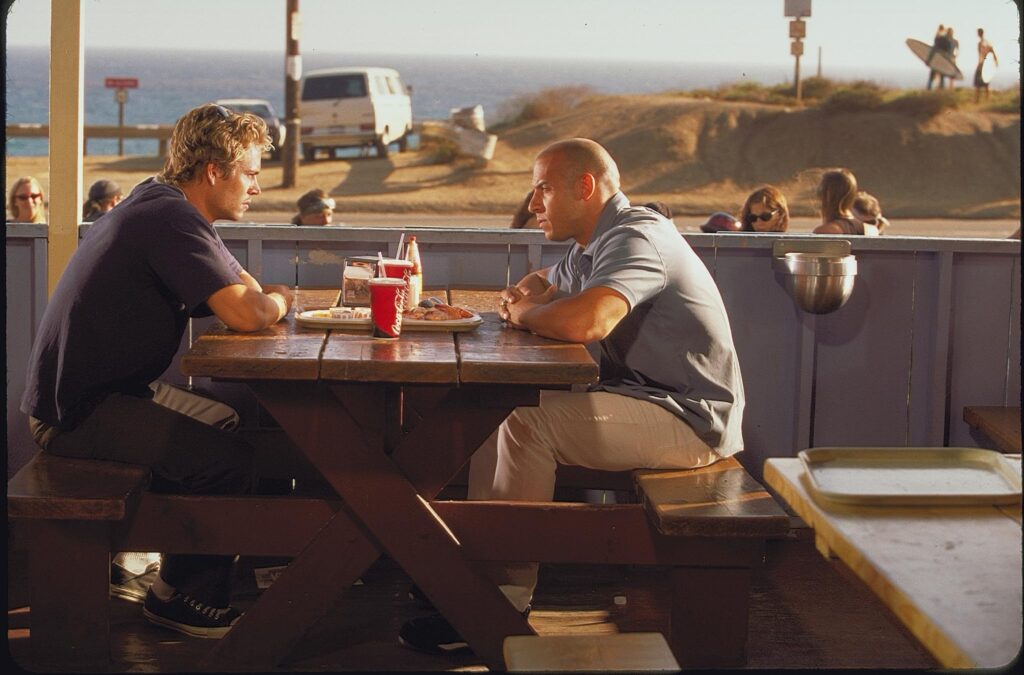
The casting was crucial. Paul Walker came aboard immediately, bringing his all-American good looks and genuine love of cars to the role of Brian. Vin Diesel was a harder sell—he had only played supporting roles up to that point, and the studio initially wanted Timothy Olyphant for Dom. Olyphant passed, suggesting the film would be “stupid,” and Diesel was convinced to take the role that would define his career. The chemistry between Walker and Diesel was immediate and electric—the earnest cop and the intense outlaw, drawn together by their shared need for speed.
The production was a lesson in making a blockbuster on a budget. Cohen wanted practical effects wherever possible, so the production built seven different versions of the Mitsubishi Eclipse hero car and created innovative rigs to capture the racing sequences. The “Mic Rig,” designed by stunt coordinator Mic Rodgers, was an elongated van with a flatbed that could mount picture cars and keep up with actual race speeds—a leap forward in filming technology that allowed for shots previously impossible. Real street racers were recruited as extras and technical advisors, including RJ De Vera and Craig Lieberman, who ensured the car details were authentic.
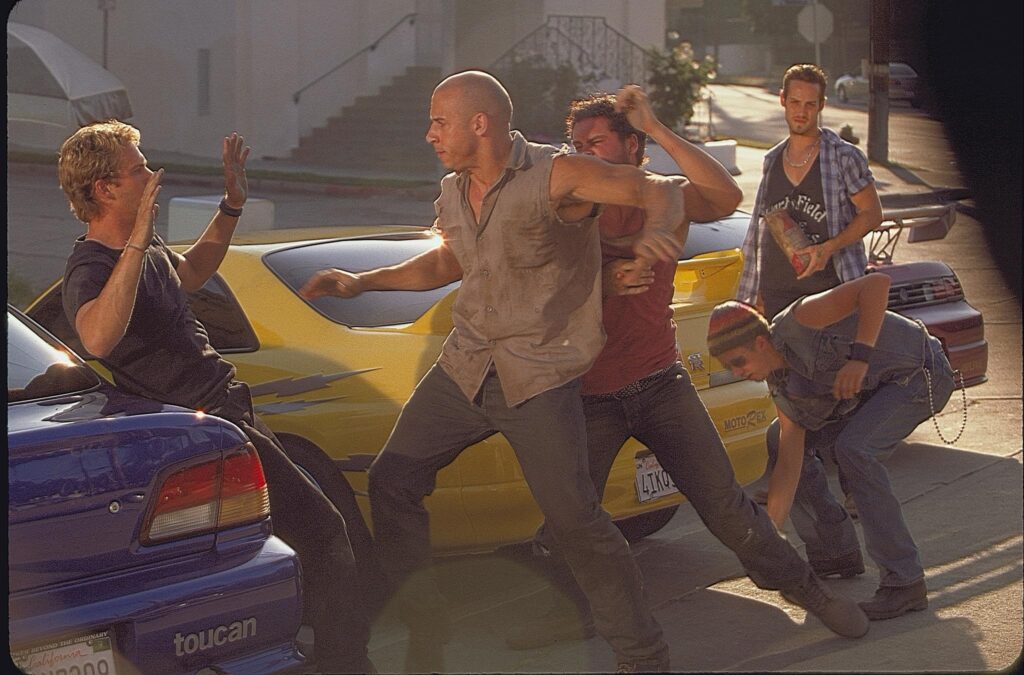
The film’s setting in Los Angeles was crucial. Cohen shot in neighborhoods like Angelino Heights, Silverlake, and Echo Park—areas that felt lived-in and multicultural, far from the typical Hollywood gloss. The “Race Wars” sequence, filmed at San Bernardino International Airport with 1,500 import car enthusiasts, captured a genuine subculture that had never been portrayed in mainstream cinema. The heat was brutal—temperatures hit 112 degrees—but the resulting footage had an authenticity that CGI couldn’t replicate.
When The Fast and the Furious opened in June 2001, it earned $144 million domestically and $207 million worldwide—surprising numbers for a $38 million film with no stars and a derivative plot. But audiences responded to the chemistry between Walker and Diesel, the fetishistic attention to car detail, and the themes of loyalty and family that would eventually become the franchise’s signature. It was Point Break, sure, but it was Point Break with a multicultural cast, a hip-hop soundtrack, and a genuine appreciation for automotive culture.
Cohen and Diesel declined to return for the sequel, assuming the story was complete. But the franchise had other plans. 2 Fast 2 Furious proved there was life without Diesel; Tokyo Drift proved there was life without Walker; and Fast & Furious proved that bringing the original cast back together could reignite the magic. From there, the franchise evolved from street racing to heist films to superhero blockbusters, each installment bigger than the last.
But it all started with a magazine article, a director who liked cars, and two actors who found lightning in a bottle. The Fast and the Furious shouldn’t have worked, shouldn’t have spawned a franchise, shouldn’t have become a billion-dollar juggernaut. But sometimes, the best things come from humble beginnings—and a really good knockoff of a Kathryn Bigelow movie.
Go back to where it all began—watch The Fast and the Furious (2001) and see how a simple story about street racing launched cinema’s most improbable franchise.
Also Read: The Battle of Coruscant Is Still the Gold Standard for Space Combat